Coaches’ equipment: the age-group baseball field, baseballs, bat, hitting/pitching net, batting tee, catcher’s gear, cones, glove and buckets for easy ball placement. Players bring: their own glove, bat and helmet at minimum. Use age-appropriate balls; soft practice balls are used for beginner contact and short side toss. Inspect the net and use it for its intended purpose. Keep catcher’s gear available; specialized catching and pitching activities require the appropriate protection and supervision. Water and the field’s first-aid provisions should be available.
Use 3 separated zones. Head coach supervises the only active hitting lane; Assistant 1 supervises fielding; Assistant 2 supervises the third station. A coach stays with each group. Nobody swings in a waiting area; keep buckets and idle bats off routes.
H · Head coach: hitting into the net in an isolated outfield corner.
F · Assistant 1: fielding lanes in the opposite outfield area.
R · Assistant 2: bases and movement in the infield.
Zone map, not to scale. Adjust to field shape, net coverage and missed-ball paths. Place every waiting area outside swings, feeds and net rebounds. Stop and reposition if zones cannot be separated.
For this session use 3 zones only. Check actual ball flight and net rebound paths; the sketch cannot certify a field layout. Stop and rearrange if paths overlap. Coach feeds are controlled; no full-field live batting or protective L-screen is assumed.
For pitching/catching modules, check current division rules and all recent throwing before participation. Resting players use the no-throw option. No velocity, innings or bullpen prescription. Stop throwing for pain or fatigue. Catcher modules require correctly fitted complete gear and soft feeds; there is no live batter.
For ages 3–4, use playful 30–60-second bursts and pauses. Finish early if attention drops. For older beginners, start with the simpler activity even in a returning-player week.
Run sheet
Today: Show a favorite contact, stop and base route; celebrate each child’s progress.
0–5 minMovement and stop-signal warm-up
5–10 minStep toward a target
10–13 minWater and group assignments
13–49 min3 stations · 3 rounds of 12 minutes
49–52 minWater and regroup
52–57 minCone bowling
57–60 minReview, celebrate and collect
Each round includes 10 minutes of explanation and turns + 2 minutes to stop, collect and walk. Coaches stay; groups rotate. Water remains available throughout.
Coaches stay; groups rotate
Round
H · Head coach
F · Assistant 1
R · Assistant 2
1
Group A
Group B
Group C
2
Group C
Group A
Group B
3
Group B
Group C
Group A
Group A: ____________________
Group B: ____________________
Group C: ____________________
Warm-up: bats away; walk, jog and side-shuffle in a clear area, then practice the stop signal. Begin easy.
Throwing: Put a cone gate on the ground with a clear stopping area beyond; nobody stands in or behind it. Use comfortable effort, ready targets and pauses; time is not continuous throwing.
Coach station cards
H · Head coach · 10 minutes including turns and explanation
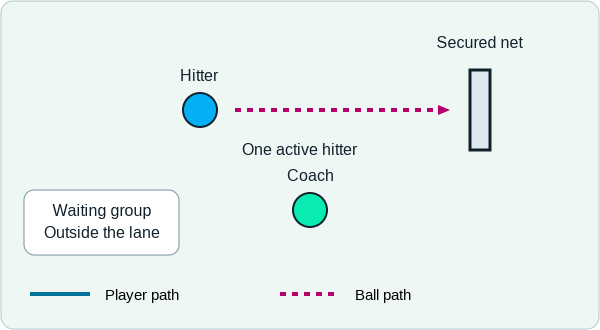
Balanced tee contact
Setup schematic, not to scale or a body-mechanics demonstration. Blue solid = player route; pink dashed = ball path. Follow the written sequence; keep waiting players clear of swings, flight and rebounds. Mirror player footwork for left-handed players when needed.
Secure the hitting net according to its instructions. Put a tee in the hitting lane and mark a waiting area outside the swing, ball and rebound paths. Only the helmeted active hitter holds a bat.
Set feet comfortably apart with relaxed knees and both hands together on the handle. Adjust the tee near a comfortable belt-level height, with the ball slightly in front of the lead hip for basic middle contact and within easy reach. Start with controlled swings toward the net and a balanced finish. The hitter puts the bat down before the coach adjusts the tee.
Use three swings per turn, then put the bat down and change hitters. Collect together only after the coach stops hitting. Use soft age-appropriate balls for beginners. For a child not ready to swing, put the bat away and practice tracking a gentle roll instead.
Say: Watch the ball; finish balanced.
Rotate: two or three attempts, then change active player. Waiting players rehearse a bat-free ready position outside the lane. Stop the station before collection; stop all stations before group rotations.
Adapt and check readiness
Easier: Use a larger soft ball, simplify the swing and adjust the tee to comfortable contact.
Progress: Repeat balanced contact before changing one tee location.
Check: Player remains balanced and follows the bat-down routine.
Age band is a starting point. Repeat the simpler task if attention, receiving or balance is unreliable.
F · Assistant 1 · 10 minutes including turns and explanation
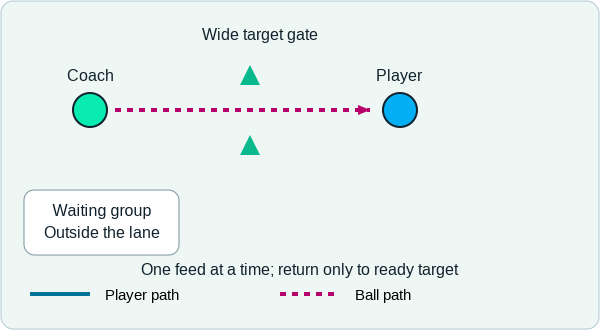
Stop and roll through a gate
Setup schematic, not to scale or a body-mechanics demonstration. Blue solid = player route; pink dashed = ball path. Follow the written sequence; keep waiting players clear of swings, flight and rebounds. Mirror player footwork for left-handed players when needed.
Make a wide gate with two cones. Coach rolls a soft ball toward the active player from a few steps away.
Player bends knees and lowers the open glove or hands in front to meet the ball. Keep the glove opening toward the roll, secure it before lifting, then roll back through the gate. A right-handed thrower wears the glove on the left; reverse for a left-handed thrower.
After three rolls, switch the active player. Coach controls feeds; other players rehearse the ready position outside the ball lane.
Say: Low hands; stop it in front.
Rotate: two or three attempts, then change active player. Waiting players rehearse a bat-free ready position outside the lane. Stop the station before collection; stop all stations before group rotations.
Adapt and check readiness
Easier: Use a larger soft ball and wider gate.
Progress: Narrow the gate slightly after controlled returns.
Check: Player watches the ball into the stop before returning it.
Age band is a starting point. Repeat the simpler task if attention, receiving or balance is unreliable.
R · Assistant 2 · 10 minutes including turns and explanation
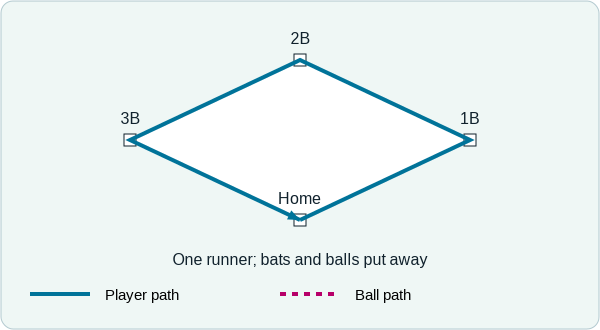
Know the base order
Setup schematic, not to scale or a body-mechanics demonstration. Blue solid = player route; pink dashed = ball path. Follow the written sequence; keep waiting players clear of swings, flight and rebounds. Mirror player footwork for left-handed players when needed.
With no bats or thrown balls active, use the field’s bases or cone markers in their normal order.
Walk home → first → second → third → home. Name the next base before moving.
Progress to a relaxed jog, one runner on the route at a time. Waiting players point to the next base from outside the route.
Say: Find the next base.
Rotate: two or three attempts, then change active player. Waiting players rehearse a bat-free ready position outside the lane. Stop the station before collection; stop all stations before group rotations.
Adapt and check readiness
Easier: Visit only home and first.
Progress: Use a coach stop signal while keeping the correct order.
Check: Player follows the route and responds to the stop signal.
Age band is a starting point. Repeat the simpler task if attention, receiving or balance is unreliable.
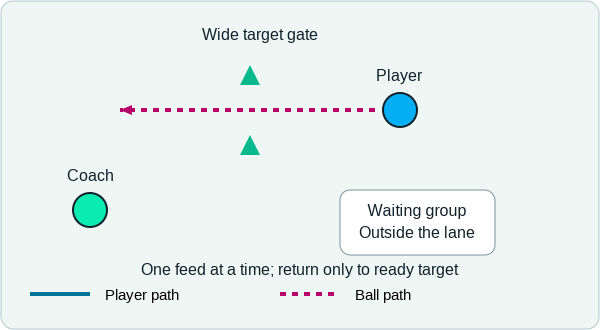
Setup schematic, not to scale or a body-mechanics demonstration. Blue solid = player route; pink dashed = ball path. Follow the written sequence; keep waiting players clear of swings, flight and rebounds. Mirror player footwork for left-handed players when needed.
Put a cone target at the end of one clear rolling lane. Waiting players stay behind a side cone.
One player rolls a soft ball toward the cone; coach returns it only when the player is ready.
Each player gets two rolls. Count team target touches; collect only when the lane is stopped.
Say: Look, roll, watch.
Rotate: two or three attempts, then change active player. Waiting players rehearse a bat-free ready position outside the lane. Stop the station before collection; stop all stations before group rotations.
Adapt and check readiness
Easier: Use a closer, wider target.
Progress: Move one small step farther while control remains comfortable.
Check: Player rolls toward the target and waits for the return.
Age band is a starting point. Repeat the simpler task if attention, receiving or balance is unreliable.
All stations stop first. For a defensive task, head coach feeds one ball; Assistant 1 manages active roles and Assistant 2 supervises the waiting group. For a base route, one runner works while the others point or rehearse ready position outside the route. Stop the block on time and rotate roles after two examples.
Wrap-up: ask each player for one useful cue or decision from today. Praise a specific effort. Name one task to repeat next time; no player ranking.
Repeat, progress or simplify?
Player watches the ball into the stop before returning it. If this is inconsistent, repeat the simple feed. If comfortable, add only one movement or decision. Week numbers do not require advancement.
Original LFB plans and activity instructions, informed by the resources below. Timing, age adjustments and weekly sequencing are LFB coaching decisions. These are not official or endorsed league curricula. Reviewed October 21, 2026; updated when guidance or content changes.
Little League: tee hitting: Contact practice from a tee; LFB supplies timing, age adjustments and turn structure.
Use current local division rules for game formats, equipment and throwing limits. The series includes introductory position modules, not a complete pitching workload or specialist catcher program.